
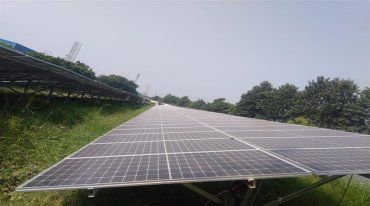
The roof has reached its limit
Old sheets, weak purlins or a roof already full of modules. A ground array adds capacity without adding a kilogram to the building.
Ground mount
A ground array turns land inside your factory boundary with nothing planned on it into daytime power for your own network, with no wheeling or transmission charges and no surcharges. Adhvanik Energy builds and maintains it.
When it fits
Ground mount is for high daytime loads and roofs that can't take more load.
Old sheets, weak purlins or a roof already full of modules. A ground array adds capacity without adding a kilogram to the building.
Furnaces, compressors and process lines can draw far more than any roof can supply. Land inside the fence closes the gap.
Ground mount uses unused land inside the boundary: a strip along the boundary, a reserved plot or ground between buildings with no other use for now.
Compare
Three places to put solar for one factory, and the differences come down to grid charges and what limits the size.
| Item | Ground mount | Rooftop | Open access |
|---|---|---|---|
| Where it sits | On land inside your boundary | On your factory roofs | On a solar park elsewhere, usually in your state |
| Wheeling, transmission and surcharges | None: power is used behind your meter | None: power is used behind your meter | All apply, along with network losses |
| Limited by | Free land and its shading | Roof area, structure and condition | State open access rules and your contract demand |
| Maintenance access | At ground level, easiest of the three | Walkways and safety lines on the roof | Handled at the remote site |
| Best when | Land is free and the roof is full or unsuitable | Sheds or slabs are large and sound | Demand is far larger than everything on site can supply |
Read more about metal sheet roofs, RCC roofs and open access.
Site engineering
A roof plant inherits its foundations from the building. A ground plant needs its own, plus drainage, fencing and a route back to your panel.
How it works
An ROI sheet, a policy check, the land area available, and a budgetary quote.
Soil investigation, foundations, row layout, fencing and the cable route.
Adhvanik designs, procures, builds and commissions the plant, with a 1-year defect liability period on the entire installation.
Monitoring on Asset Connect, inspections and repairs, with a monthly report.
Operations
Everything is at ground level, so cleaning and repairs are quicker and safer than on a roof. The extra jobs are vegetation control, fence and gate checks and keeping the drains clear after the monsoon.
Reporting and guarantees
Why Adhvanik
HUL – Orai (1,131 kWp), HUL – Haridwar, 332 kWp and MDB Chemicals – Jalgaon (176 kWp) are ground-mount plants we built.
Syngenta – Aurangabad (404 kWp) was financed as PPA / OPEX; the others above as CAPEX.
Its own foundations, structure and fence make a ground plant cost more per kWp than a roof plant; what it earns back is the size the roof could not reach. CAPEX: you own the plant from day one, with the highest lifetime savings. PPA / OPEX: Adhvanik invests, owns and runs the plant; you pay per unit, with zero upfront investment and a tariff set in the contract, below your grid rate, on 5–25 year PPAs, with PPAs running to 2040 and 2051.
How CAPEX works · How a PPA works · Compare CAPEX and PPA
Guides: Metal sheet, RCC, ground mount or carport: choosing the installation · Behind-the-meter or net metering: which suits your site?
Glossary: Behind-the-meter · kWp vs kW · Performance ratio (PR) · Full glossary
Projects
Every ground-mount plant on our published project list, newest first. Capacities are DC unless marked AC.
Read the case study
Common questions
The questions that come up once a site team starts looking at spare land.
Speak with an industrial solar engineerIt depends on your site’s shading, the shape of the plot and the row spacing the layout needs, so we work it out from your site plan and the feasibility check. Long, narrow strips along a boundary can work as well as square plots.
As near as the land allows. Extra cable adds cost and losses, so a distant plot has to earn its place with more capacity or cheaper land. If the only free land is far away, we compare it with bringing the power in at a nearer connection point.
A ground-mount plant inside your boundary feeds your own network behind the meter, so no transmission or wheeling charges and no surcharges apply. Open access brings power from a plant outside your premises over the grid, and those charges do apply. Inside the fence is usually cheaper per unit; open access is for demand your own land and roofs cannot meet.
Yes, and many sites should. The roof takes what it safely can, and the ground array adds the rest, both behind the same meter. The feasibility study sizes them together against your daytime load.
Tell us at the start. We only plan on land you do not expect to use during the plant’s life, and the layout can leave a reserved strip for a future building or road.
Our maintenance contracts carry a 95% uptime guarantee plus a performance-ratio guarantee. Lost generation is credited at ₹3.00/kWh. On the plants we maintain, generation has typically run 3–7% above the guaranteed yield.
Free feasibility study
The feasibility study is free, takes 7 days and carries no commitment. An engineer replies within 48 hours.
What the study covers