
Battery storage · New
Battery storage that cuts your peak demand
Battery storage is Adhvanik Energy’s newest service: peak shaving and demand-charge reduction, plus firm power for the hours your solar plant cannot cover. We size it from your own meter data.
- an engineer gets back to you
- 48 hours
The problem
Three jobs a battery does at a factory
Most sites need one or two. Savings and payback vary with your tariff structure, load shape, demand charges, cycling and backup needs, so we model them from your own meter data.
| Use case | What the battery does | What decides the saving |
|---|---|---|
| Peak-demand reduction | Discharges when demand spikes, so the highest reading your meter records in a month is lower. | Your tariff’s demand charge, and the minimum billing demand it sets (often a share of contract demand). |
| Backup and power reliability | Carries sensitive loads through short grid interruptions and bridges outages that would otherwise start the DG set, if the system is specified for backup operation. | How sensitive your process is to a short interruption, how often the DG starts and what each start costs in fuel and wear. |
| Solar shifting and consumption optimisation | Stores midday solar or off-peak grid power and releases it in the peak-rate slots. Where export is limited, it absorbs surplus solar for use later in the day. | The gap between peak and off-peak rates in your time-of-day tariff, and your state’s export rules. |
How it works
One high reading on your meter sets part of the bill
Rooftop solar peaks around noon. Many factories peak later, when shifts overlap, and a battery discharges into that peak so the maximum demand your meter records stays lower.
- Factory load
- Rooftop solar
- Battery discharge (peak shaved)
- New maximum demand
When it pays
Which factories a battery suits, and when it is worth modelling
If two or more of these are true for your site, it is worth running the numbers.
Worth modelling when
- Demand charges are a large share of your monthly bill
- Your load has a sharp peak, often in the evening or when shifts overlap
- Your state’s time-of-day tariff has a wide gap between peak and off-peak rates
- Short grid interruptions trip lines or start your DG sets several times a month
- Midday solar is wasted or curtailed because export is limited
What we look at
- Interval data from your meter, ideally a full year, to see every peak
- Your tariff: demand charges, time-of-day slots and the rates in each
- DG run hours and what each start costs you in fuel and wear
- The output of your existing or planned rooftop solar, slot by slot
- Space, ventilation and fire-safety arrangements for a battery room or container
Economics
How the economics work, and what they leave out
The saving is a lower maximum demand times your demand charge each month, the peak and off-peak rate gap on the energy you shift, and the diesel you stop burning. The cost includes replacement if the battery’s life is shorter than the period you are analysing.
Two factories with the same battery can have different paybacks, so we model your meter data. Battery storage is a new service for us, so we do not quote a typical payback.
What goes into the calculation
- Savings
- Demand charge reduced, peak-slot energy shifted, DG fuel avoided, extra solar used on site.
- Costs
- Battery, inverter and controls, installation, round-trip energy loss, space and fire-safety works.
- Risks
- A tariff change that narrows the peak and off-peak gap, battery wear faster than modelled.
Sizing
Two numbers size a battery
Get either one wrong and the battery cannot shave the peak, or runs flat before the peak is over.
Power
How much load the battery can carry at once. This sets how deep a peak it can shave.
Energy
How much it stores. Power in kW multiplied by hours gives kWh, so this sets how long it can keep shaving before it runs out.
Installation and operation
What a battery asks of your site, and of your team
A battery needs a dedicated room or container close to the electrical panel it feeds.
Once running, a battery adds something new to watch: how full it is, how hot it runs and how many cycles it has done. How it is monitored and maintained, and by whom, is written into the proposal for your site.
Site requirements
- Space
- A room or container with ventilation, detection and access for service.
- Electrical
- A connection point near your LT or HT panel, and capacity for the battery’s inverter.
- Data
- A year of interval meter data and the tariff order your DISCOM bills you under.
Why Adhvanik
Why ask Adhvanik about storage
Patwari Bakers is our battery energy storage (BESS) reference project. What we can show here is the method.
Sized against your own tariff
GreenAdhvanik models tariff and returns for industrial sites. A storage assessment starts from the same bills and meter data.
Solar and storage designed together
The same engineers size solar and storage against your daytime load and your evening peak.
The model shows when it does not pay
Where a battery will not pay back, the numbers will show it.
Solar first, then storage
Start with metal sheet or RCC rooftop solar, and compare CAPEX, PPA, lease or EMI before you choose a size.
Tariff terms that decide whether a battery pays
Guide: Reading your electricity bill: the numbers that matter for solar. Terms: ToD tariff, Contract demand, or the full glossary.
Projects
Our most recent solar plants
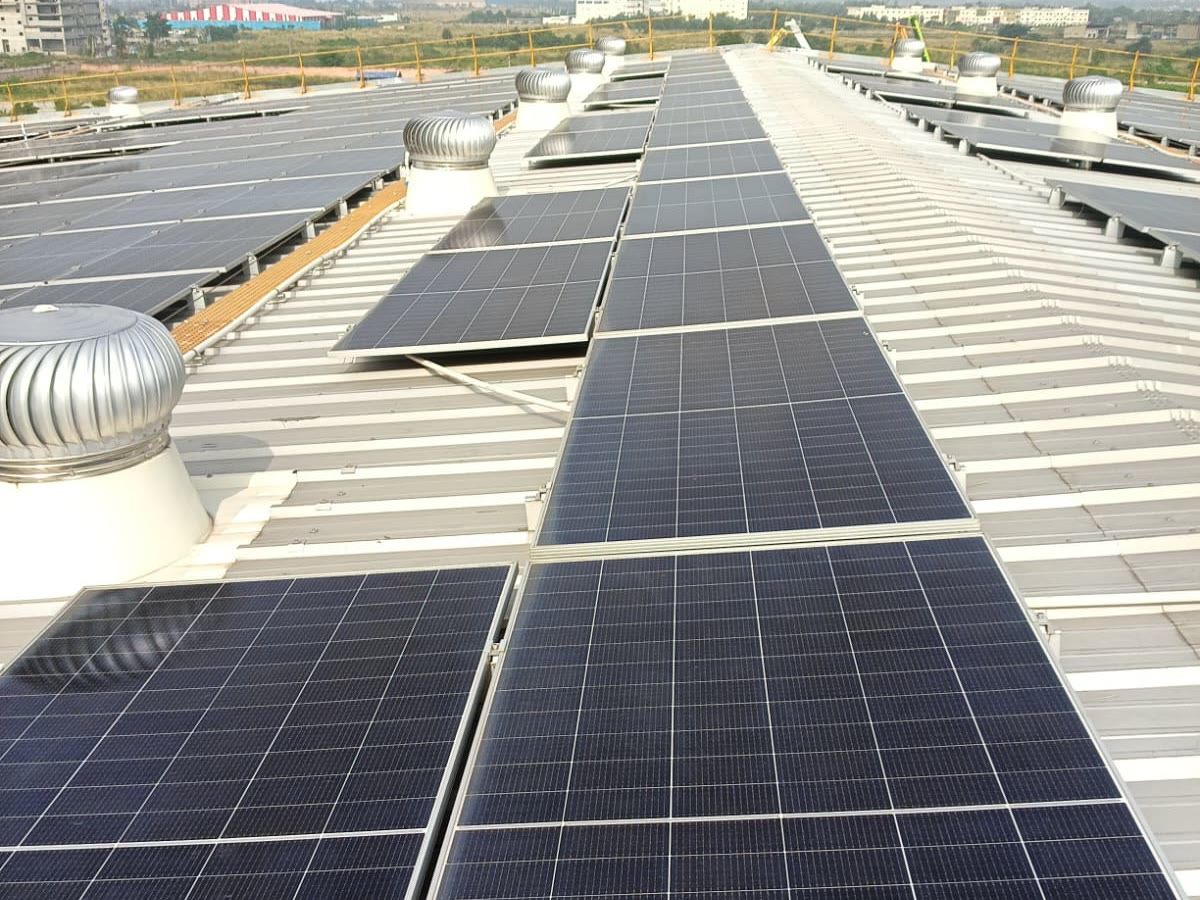
Patwari Bakers is our battery energy storage (BESS) reference project. These are the latest solar plants our team has commissioned.
Common questions
What problem it solves, what it costs and how long it lasts
What finance and maintenance heads ask about demand charges, sizing, diesel sets and battery life.
Speak with an industrial solar engineerWhat problem does a battery solve for a factory?
It shifts electricity to a different time from when it was generated or bought. That helps in three places on your bill: the demand charge, the gap between peak and off-peak rates, and the diesel you burn in short outages. Which one matters most depends on your tariff and your load.
What is peak shaving, and how does it reduce our bill?
Many industrial tariffs charge for the highest demand recorded in a billing period, not just the units used. A battery that discharges during those peaks lowers the recorded maximum demand, and with it the demand charge, down to the minimum billing demand your tariff sets (often a share of contract demand).
Which tariffs make a battery worthwhile?
Tariffs with a high demand charge, a wide time-of-day spread, or both. Where demand charges are low and rates are flat through the day, a battery is hard to justify on savings alone.
Do we need rooftop solar to benefit from a battery?
No. A battery can charge from the grid in off-peak hours and still shave peaks. Paired with solar it does more: it stores midday surplus and covers the evening, when solar output has fallen away.
Can a battery replace our diesel generator?
For short interruptions, a battery specified for backup can take over many of your DG starts. Replacing a DG for long outages needs a much larger battery, and the economics rarely work. We size for the interruptions in your records.
How is a factory battery sized?
Two numbers: power in kW, which sets how much load it can carry at once, and energy in kWh, which sets how long it can do it. Both come from your interval meter data and your tariff.
How long does a battery last, and what does that do to the payback?
Battery cells lose capacity with every cycle, and heat speeds that up. The maker’s warranty states the years or cycles it covers. A payback calculation has to include that wear, and any replacement that falls inside the period you are modelling.
Is a battery room a fire risk?
It is a design item like any other electrical room. Space between units, ventilation, detection and the fire-safety rules for your site are settled before a battery is specified.
How do we find out if it pays for our plant?
Storage is modelled against your tariff and a year of interval meter data from your plant. The solar feasibility study itself is free and takes 7 days.
Free feasibility study
See if a battery would pay at your plant
Tell us you want storage assessed. We ask for a year of interval meter data and your tariff. An engineer replies within 48 hours.
What the study covers
- Financial ROI sheet based on a preliminary design
- Policy check for your state and connection
- Roof feasibility and the area available for installation