A load that runs late
Cooling, kitchens, laundry and hot water keep a hotel drawing power well into the evening. Part of what a plant makes in the day is used on site, but evenings stay on the grid.
Hotels & offices
Our track record is in factories. A hotel runs all day and all night, an office runs on weekdays, and in both the roof and the lease are shared with other people. So we start from your bill and your roof, and we tell you early if it is not worth a study.
Load shape
Both are commercial buildings, but a hotel never sleeps and an office does.
Schematic: a morning peak, a long daytime plateau and a strong evening peak. Drawn to explain the pattern, not measured at any site.
Schematic: weekday working hours, little at night or at weekends. Drawn to explain the pattern, not measured at any site.
Hotels
Cooling, kitchens, laundry and hot water keep a hotel drawing power well into the evening. Part of what a plant makes in the day is used on site, but evenings stay on the grid.
Chillers, cooling towers, tanks, pools and event decks compete with panels for the same terrace. Usable area usually limits a hotel plant.
A resort or a business hotel has busy and quiet seasons. A plant sized for the busy month will out-produce a quiet one.
Many hotels heat water with boilers, heat pumps or solar thermal collectors. Solar thermal on the same terrace takes area that panels would need, and a generator or boiler room nearby shapes where cables and inverters can go.
Offices
An office draws most of its power on weekdays between morning and evening, which lines up well with solar output.
On weekends and holidays the building uses far less, so the plant makes surplus. What happens to it depends on your state’s export rules.
In a multi-tenant tower the roof belongs to the landlord and the tenant pays only for its floor. Who can sign for the plant is the first question.
Central chillers or VRF air conditioning are the biggest load in most offices, and they peak in the mid-afternoon, close to the peak of solar output.
Which model
The model follows ownership, and in commercial buildings ownership is often split.
| Your situation | Who pays the power bill | Model that usually fits | Why |
|---|---|---|---|
| You own and run the hotel | You | CAPEX or PPA / OPEX | The same choice as a factory: CAPEX for the highest lifetime savings, PPA if you would rather not spend capital. |
| The hotel is leased or managed for an owner | Operator or owner | PPA / OPEX, with the owner’s consent | A plant outlives most management contracts, so the owner has to be inside the agreement. |
| You own the office building or campus | You, or tenants through charges | CAPEX or PPA / OPEX | One owner and one roof keep it simple. How tenants are charged is a matter for the leases. |
| You are a tenant on one floor | You | Usually none on the roof | You rarely control the roof. A conversation with the landlord comes first, and the case may sit with them. |
| Your load is large and your roof is small | You | Rooftop plus off-site solar | A multi-storey building has little roof for its load. Open access can cover more than a terrace can. |
Your tariff
Commercial buildings are billed in different tariff categories from factories, and categories and rates differ by state. So there is no honest typical saving for a hotel or an office.
What matters is your own cost per unit, the hours you use it and what you can export. The bill tells us all three. The guide to reading your electricity bill shows which lines to look at.
Straight talk
Four limits that come up more often in commercial buildings than in factories.
Solar covers a slice of the load. That is still a saving, but for some towers it is too small to be worth the effort.
Panels do not make power at night. A building that uses most of its power then will see a smaller saving.
If you could be gone before the plant has paid back, the roof is not yours to commit.
A terrace used by guests or staff needs fencing and safe access. The building's fire officer and the local authority may have a say on structures and cable routes, and a high-rise terrace has a wind load that a factory shed does not. Where these cannot be met, the plant should not go there.
Our hotel plants
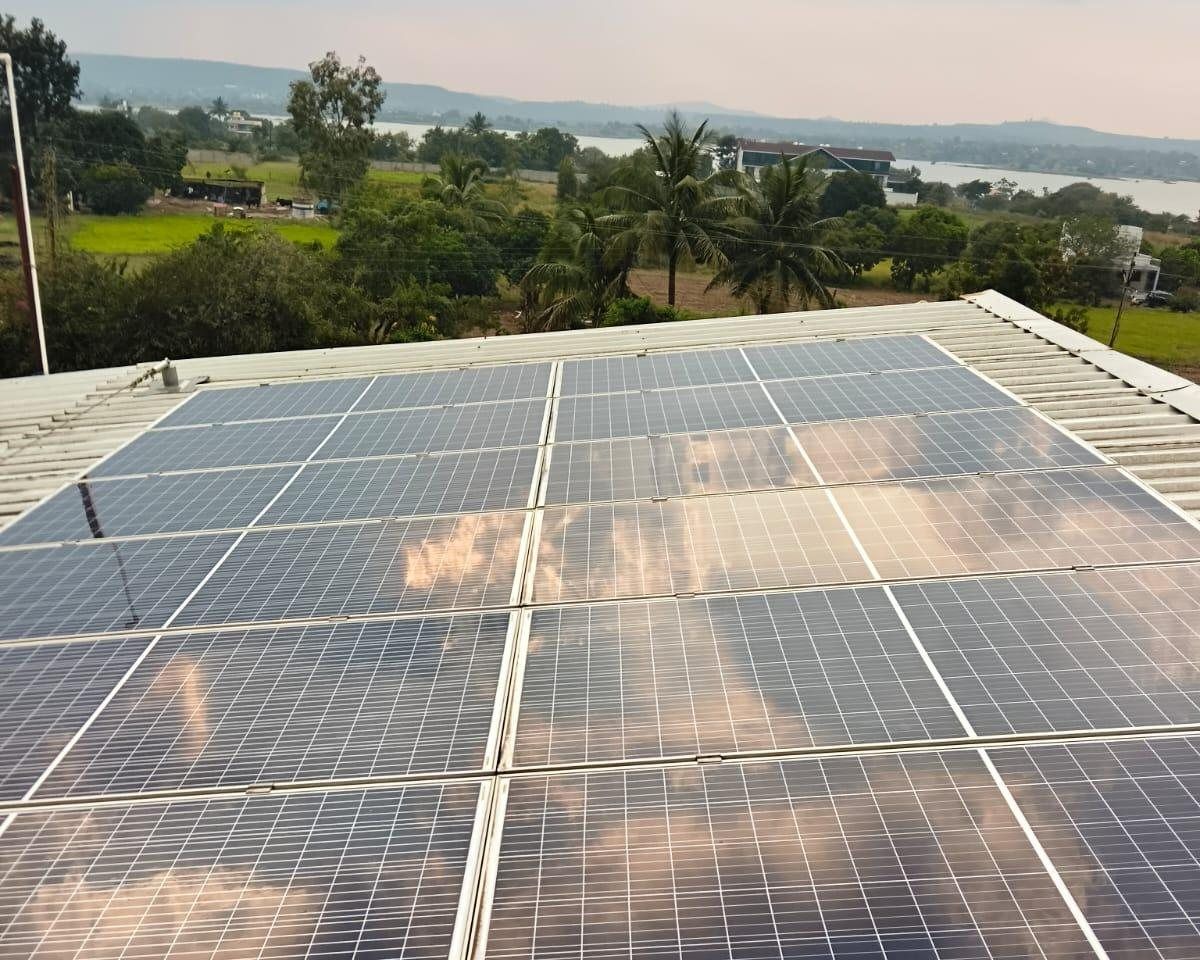
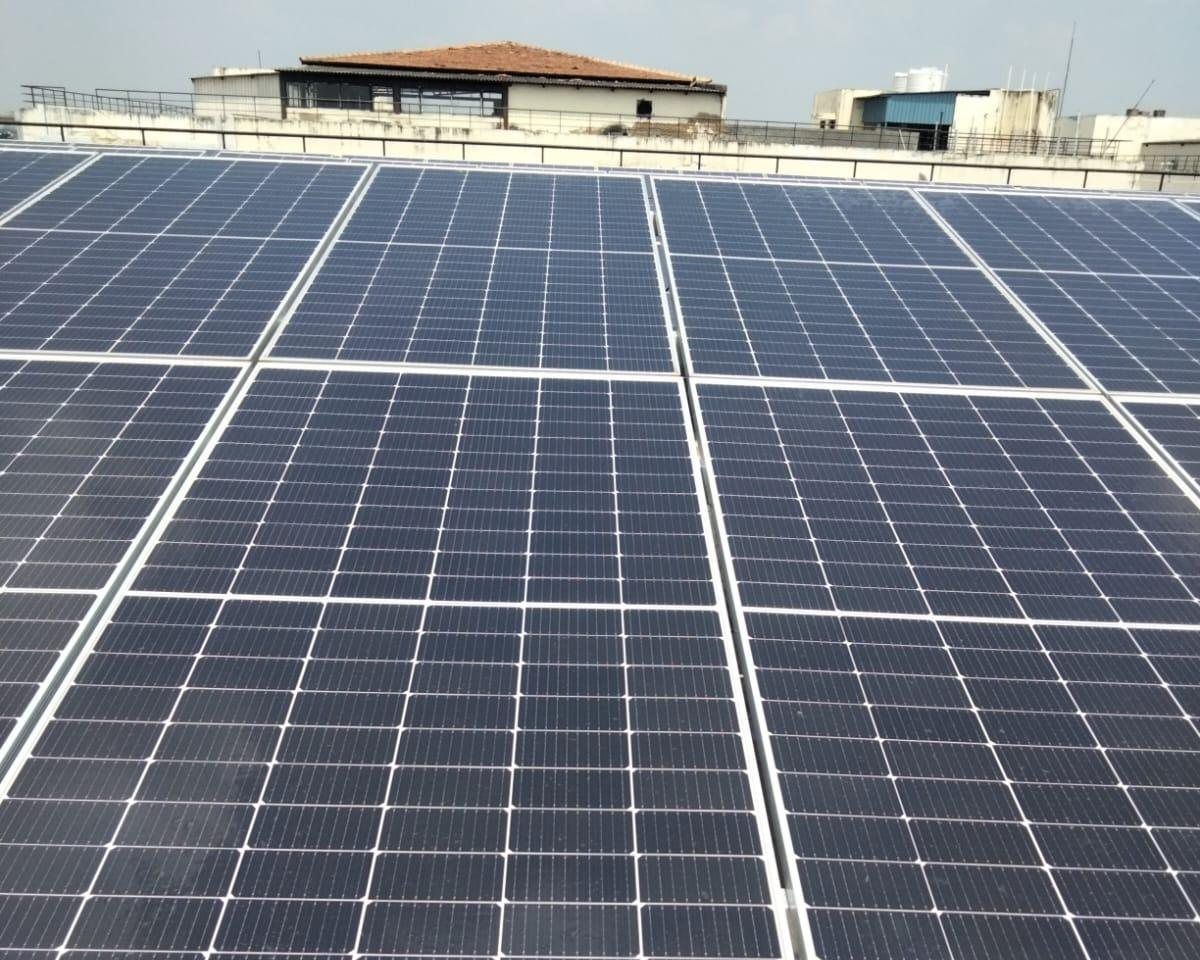
Rooftop plants at Soma Resort in Nashik, followed by factory plants on RCC (flat concrete) roofs, the closest comparison for a commercial terrace.
Guides and glossary
Terms used on this page
No. We do not serve homes / housing societies or small shops. We build for factories first. If you run a large hotel or office, tell us your town and average monthly bill and we will say whether a study is worth it.
No. Panels make power in daylight only, so evenings and nights stay on the grid. A plant reduces the daytime share of the bill.
Rarely on your own. The roof belongs to the landlord, so the conversation starts with them. If you want to explore it, tell us the building’s town and your average monthly bill and we will say whether it is worth raising.
The same two as a factory: CAPEX, where you own the plant, or PPA / OPEX. Under a PPA: Adhvanik invests, owns and runs the plant; you pay per unit. The free study gives you an ROI sheet and a budgetary quote for your site.
Yes. We built two rooftop plants at Soma Resort in Nashik, an existing plant and a newer one; both are shown above with their own pages. Ask us and we will tell you whether a site visit can be arranged.
It covers financial ROI sheet based on a preliminary design, policy check for your state and connection, roof feasibility and the area available for installation, and budgetary quote. It takes 7 days and is free.
Free feasibility study
Tell us the town, the building type and the average monthly bill. An engineer replies within 48 hours.
What the study covers