The challenge
Going green without tying up capital
Dabur wanted to go green and reduce the carbon intensity of its operations, but it wanted its capital free for expanding its core business. So it looked for a partner that would take on the capital and the operating burden of a solar plant, and still deliver cost savings and lower emissions.
Both Dabur units at Pantnagar combine metal sheet and RCC roofs, and each roof type has its own failure risk. Screw a structure through a metal sheet and every fixing is a possible leak, and a likely breach of the sheet maker’s warranty. Anchor into an RCC slab and you cut through the waterproofing that keeps the floor below dry.
The solution
How the plant was engineered
Adhesive mounting on metal sheet
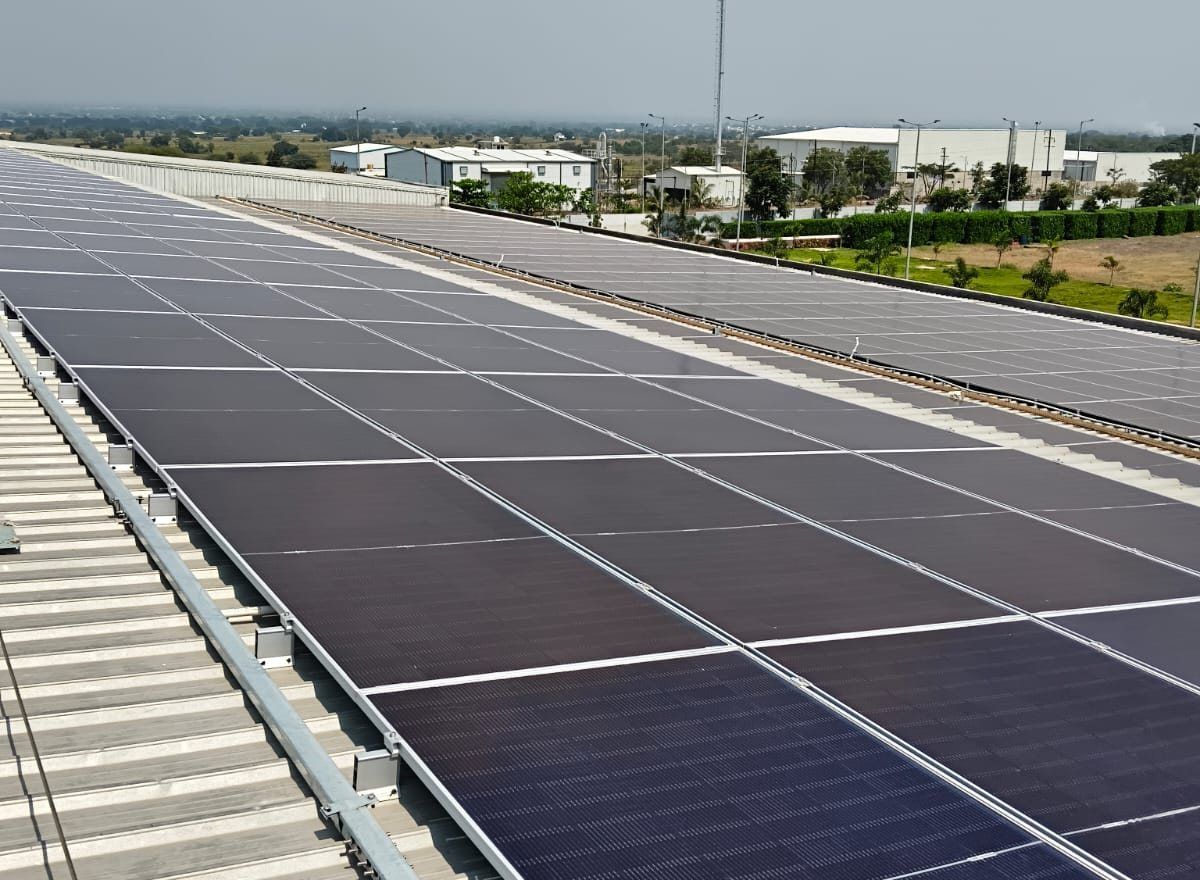
Rails are bonded to the sheet with adhesive instead of being screwed through it, for a roof with no fixings to seal.
Ballast on RCC
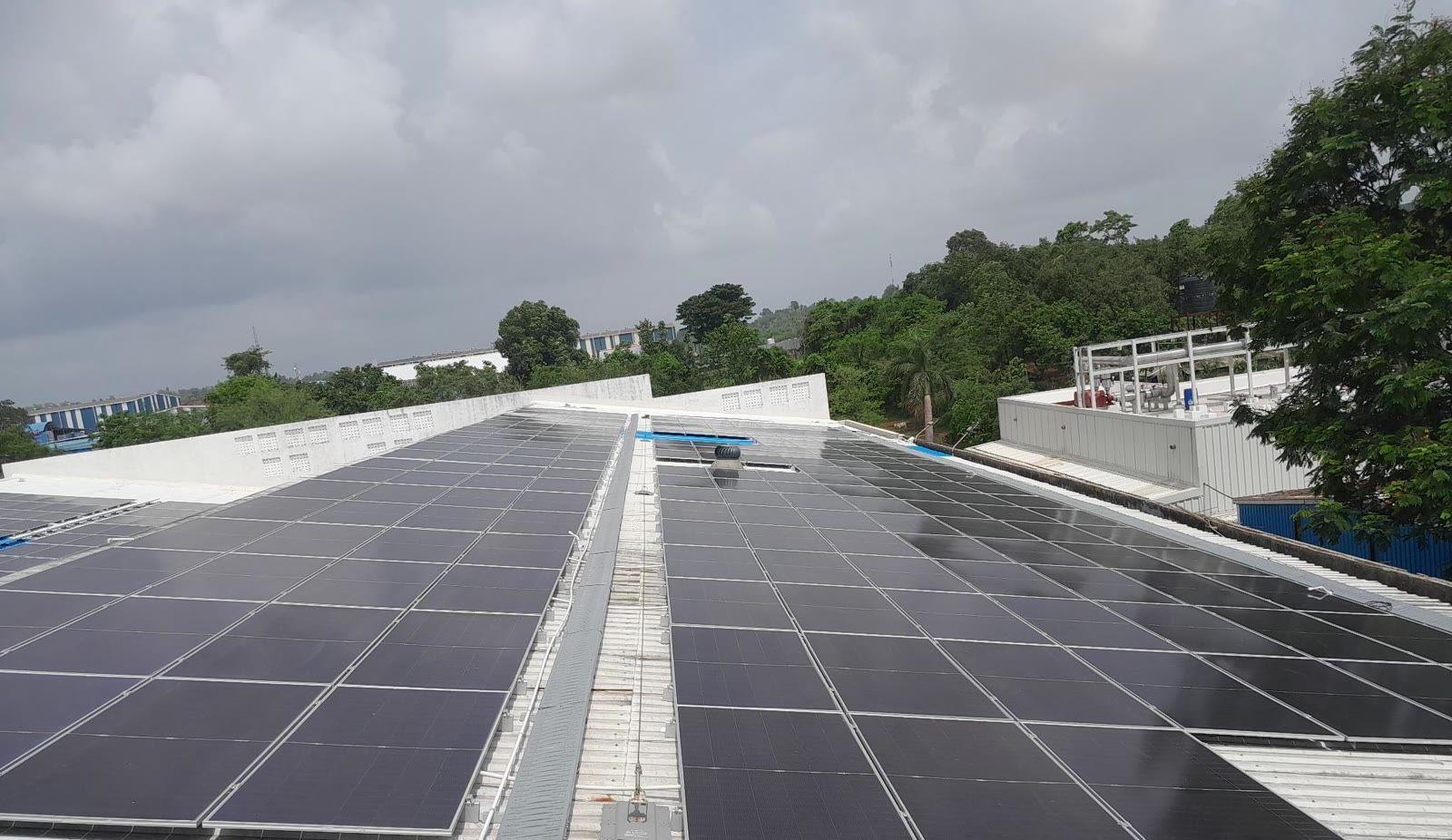
On the slabs, the structure is held down by weight and not by anchors, and it is designed for the wind speed under IS 875, as applicable.
Safe access on both roofs
Walkways and safety lines by design, so cleaning crews and engineers can reach every row safely.
Bifacial modules over the RCC
Adhvanik used bifacial modules to capture extra light reflected off the RCC surface. An experimental white-paint coating on the RCC roof raised yields by 2–4%.
Implementation
How it was delivered
Adhvanik invested in, designed, built and commissioned the two Pantnagar plants, and operates them under the PPA.
Finance model
Adhvanik owns the plant (PPA)
Under the PPA, Adhvanik invests in the plants, owns them and runs them. Dabur makes no upfront investment and pays an agreed tariff for each unit the plants generate, set below its grid rate.
Because we own the plants, their performance is our responsibility. Our contracts carry a 95% uptime guarantee plus a performance-ratio guarantee.
Day to day, the plants report generation, performance ratio and alerts to Asset Connect. If something trips, our own O&M team responds remotely within 1 working day. If the fault cannot be fixed remotely, an engineer attends site within 2 working days.
Results
Dabur India plants on our published list
| Plant | Location | Roof / configuration | Finance model | Capacity | Commissioned |
|---|---|---|---|---|---|
| Dabur – Rudrapur, 1,000 kWp | Rudrapur, Uttarakhand | Metal sheet + RCC | PPA / OPEX | 1,000 kWp | Nov 2023 |
| Dabur – Rudrapur, 400 kWp | Rudrapur, Uttarakhand | Metal sheet + RCC | PPA / OPEX | 400 kWp | Nov 2023 |
| Dabur – Silvassa | Silvassa, Dadra and Nagar Haveli and Daman and Diu | Metal sheet roof | PPA / OPEX | 937 kWp | Apr 2026 |
| Dabur – Indore | Indore, Madhya Pradesh | Metal sheet roof | PPA / OPEX | 500 kWp | Feb 2025 |
| Dabur – Newai | Newai, Rajasthan | Metal sheet + RCC + Ground mount | PPA / OPEX | 480 kWp | Mar 2024 |
Performance
Three years of operation, unit by unit
Unit 2 has 1,000 kW installed and Unit 3 has 400 kW, 1.4 MW across the two plants. Both were commissioned on 1 November 2023 and have completed three years of operation.
| Year | Unit 2 PR | Unit 3 PR |
|---|---|---|
| 2023–24 | 83.7% | 80.8% |
| 2024–25 | 81.6% | 80.1% |
| 2025–26 | 81.4% | 77.5% |
Grid outages cost generation
Average grid-down time was 4% at Unit 2 and 9% at Unit 3, and the plants cannot generate while the grid is down. Adhvanik installed a DG sync on both plants to reduce the impact.
What happened next
More Dabur plants followed
Based on the plants’ performance, Dabur has awarded Adhvanik multiple projects. Alongside the two Pantnagar units, Dabur’s plants with us include Silvassa, Indore and Newai.
Photos
From the site
Does this match your site?
This approach fits if
- You want solar savings without spending capital
- Your site has more than one roof type
- You’d rather the developer carries performance risk for the full term
- You want one partner to build, own and maintain the plant
Related pages