This year’s pandemic has renewed investors’ interest in Renewables, as it’s a clean energy source that generates a stable income. Many experts have made various claims regarding the efficiency and viability of Renewable Energy sources, such as Wind & Solar.
As someone who works in this field in India, I thought it would be best to lay down the facts about which of these two energy sources is more efficient, their benefits & drawbacks, and investment returns.
Efficiency based on Plant Load Factor (PLF):
Wind Energy is much more efficient than Solar Energy in this case. Most windmills that were built in India between 2005–2015 average a PLF of 15–20%. Some windmills at sites with very high winds have an average PLF of up to 30%, and the new 2.7MW and 3MW wind turbines can achieve a PLF as high as 55–60%! However, the biggest drawback is that Windmills can only work in locations with sufficient wind speeds.
Mono-Crystalline Solar Panels can achieve an efficiency of 21%. The PLF of Solar modules is highly dependent on various factors such as, the quality of modules and the way they are installed, the solar irradiation levels at the plant, and how regularly the panels are maintained. One can install Solar panels in any place with clear sunlight, which is the pre-dominating advantage it has against Wind Power.
Benefits -
- The energy produced is clean, the parts are re-cyclable!
Solar and Wind are both non-polluting, renewable sources that emit zero carbon emissions.
We can recycle 85% of Windmill’s parts, and there is research going on to increase it 100%. Materials used to make solar panels can be recycled, too, if each layer’s components are taken apart.
- They are easy to maintain
It is relatively easy and cost-effective to maintain Solar Plants. The only requirement is to keep cleaning the panel, which can be done with clean water and a mop. With an engineer visiting once in a quarter, breakdowns at Solar Plants become extremely rare. Most plants operate 99% of the time.
Wind Turbines require more skilled maintenance as it involves many spares, oil changes. Maintenance may also occasionally need a crane, as the turbines are situated at a height of over 70–80 meters. However, there are lower chances of breakdowns if the servicing is done correctly.
- The running costs of the plant is low
Since there is no raw material, the only running cost for these plants is regular maintenance. Between the two, Solar is extremely cheap to maintain with an average maintenance cost of ₹450 per kW, while Wind costs 2–3 times more at ₹1,000–1,500 per kW. Windmills require 24/7 supervision, and also requires more technical man-power which increases the labour costs.
The cost of spares for Solar is negligible as the panels are covered under a 25 year performance warranty, while the inverters come with extended warranties of up to 10 years. The structure also comes with a 10 year warranty, which means you may not need to spend out of pocket on replacing parts in the PV plant.
- It’s Cheap Energy!
New Wind & Solar plants are providing power at a cost that’s much cheaper than Coal and Gas (Thermal). Hence, there has been minimal construction of new Thermal power plants as renewables are cheaper and environmentally friendly.
Drawbacks -
- Both have low-capacity utilization (when compared to Thermal Power Plants)
Thermal Power Plants can have PLF’s as high as 95% subject to regular maintenance.
- Location
Renewable energy is very location dependent. Windmills work best in areas with high wind speeds. In locations with less than sufficient Wind, windmills are unviable. On the other hand, we can theoretically install a Solar Plant anywhere, but the eventual output is dependent on the solar irradiation and temperature levels. Hence, a solar plant in Rajasthan would generate much more than a solar plant in Shimla.
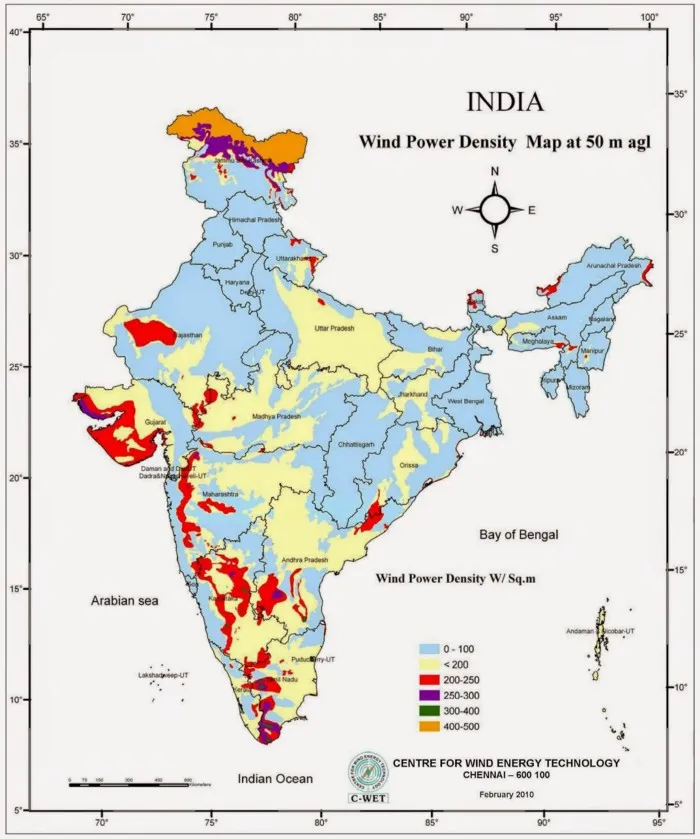
This map showcases the density of Wind Power, which helps us decide which areas are most viable to set up Wind Farms
- Intermittent Nature of Power
Solar and Wind are extremely nature dependent. Solar only works when there is sunshine, while Windmills are heavily dependent on wind speed to operate. Hence, during monsoons, windmills generate more power due to high winds and rains, while Solar generates considerably less power due to the clouds’ blockage of sunlight. Moreover, Wind generates more power during evening and night when the earth cools down while Solar generates power only during the day.
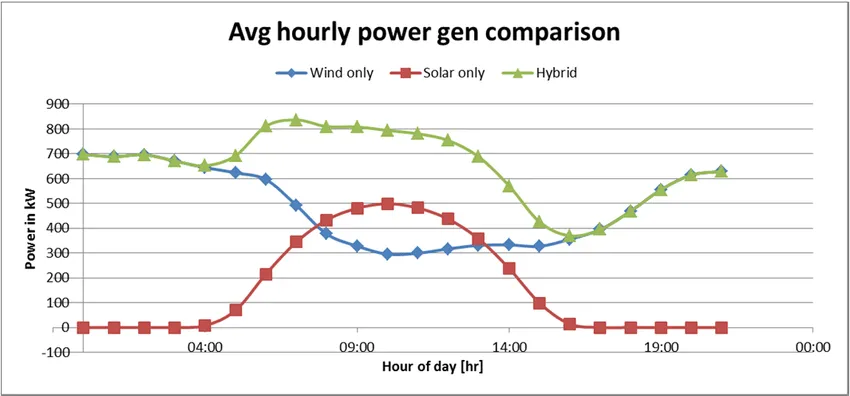
As depicted in the graph above, during the day Wind Power generation drops, while solar picks up. During the night, Solar generation is zero, while Wind peaks at night.
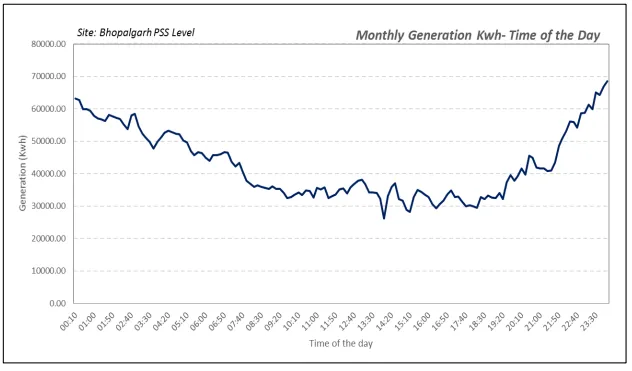
Actual generation data from a wind site in Rajasthan, August 2020
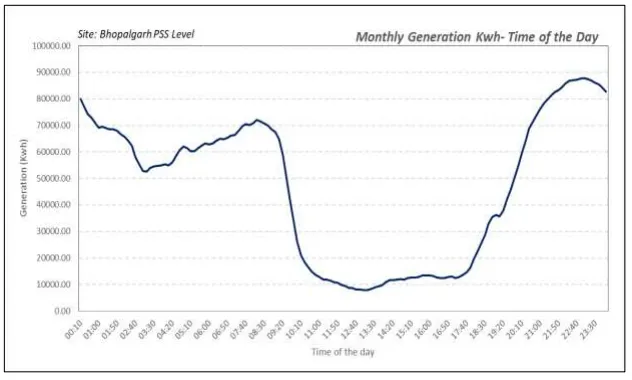
Actual generation data from a wind site in Rajasthan, December 2019
In August since it was the monsoon season, the wind speed was much higher and the site generated more power during the day as well. However December was winter and a cooler/ dryer month in Rajasthan which is a desert, therefore the generation dipped drastically and it was more pronounced during the day.
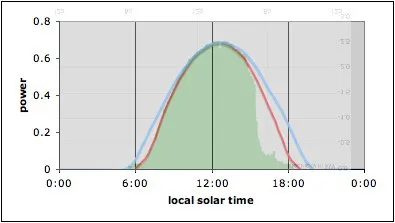
Solar generation runs only from 6 am to 6 pm, in a bell curve fashion with peak generation around 12 noon to 1pm.
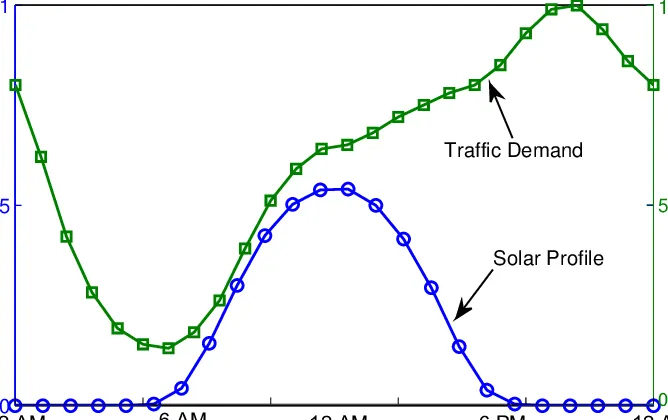
The demand for Power increases when Solar generation drops, making it a key drawback.
This dependency on nature makes both sources an unreliable source of energy compared to Thermal Power. However, with battery storage becoming more affordable by the day, we would soon be able to store excess power from renewables in batteries to be used when mother nature is not helping.
- Degradation
Like every asset, Wind & Solar both degrade over time. However, the rates of degradation are extremely low in both cases. Windmills are assumed to degrade on average by 12% over a 20 year period. However, in my experience I have seen windmills over 17 years old still continue to perform at the same PLF’s since its commissioning. The major factor that plays here is Wind speed and maintenance. Windmills when maintained by a competent O&M provider under a comprehensive AMC ensure that all parts are well maintained and replaced as and when required.
Solar on the other hand tends to degrade up to 17–18% over a 25 year period. Most module manufacturers provide a 25 year performance warranty on their Solar panels. However, it is important to inspect the panels and select a reputed manufacturer that will be able to fulfill warranty claims.
In conclusion, Wind & Solar technologies are here to stay! We are even seeing frequent technology upgrades in this space. Even though Wind Power is more efficient than Solar, its dependency on windy sites and maintenance costs makes it less attractive to solar. Moreover, Solar is a modular system, while Wind isn’t. It’s easier to install solar of any capacity, with the only constraint being the available area.
Nonetheless, both technologies offer great investment returns and stable cash flows as they are cost-efficient and proven technologies. In my next blog, I will be touching upon how renewable energy projects make money.